Same-Day Service · Flagler County
Garage Door Spring Repair & Replacement
in Palm Coast, FL
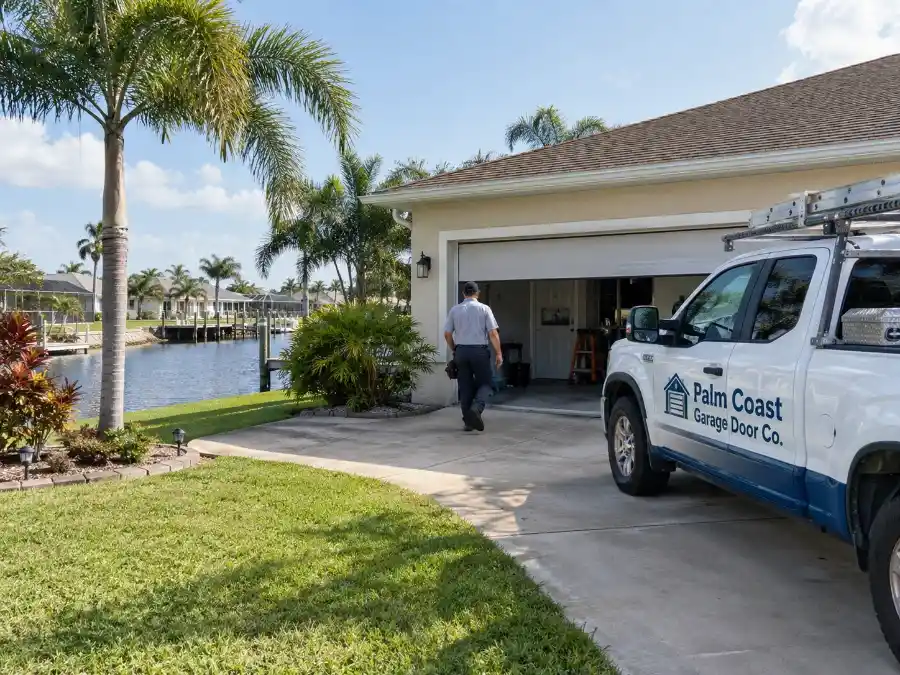
That gunshot sound from your garage — that’s a torsion spring snapping. The most common repair call we take in Palm Coast, and the one that happens faster here than any manufacturer’s spec accounts for i.e Garage Door Spring Repair & Replacement Palm Coast. Salt air from the Intracoastal cuts spring life to 4–7 years in Flagler County. Palm Coast Garage Door Co. carry high-cycle coastal springs on every truck. Same-day service on most calls. Written quote before anything gets touched.
The Local Reality
How Long Do Garage Door Springs Last in Florida?
The national average spring lifespan — 10,000 cycles, roughly 10 to 15 years — doesn’t apply in Palm Coast. Manufacturers calculate that number in inland, controlled conditions. In Flagler County, standard steel torsion springs typically last 4 to 7 years. In the highest-exposure areas — F Section canal homes along the Intracoastal, Hammock Beach oceanfront properties, and A1A beachside neighborhoods — 3 to 5 years is the realistic range.
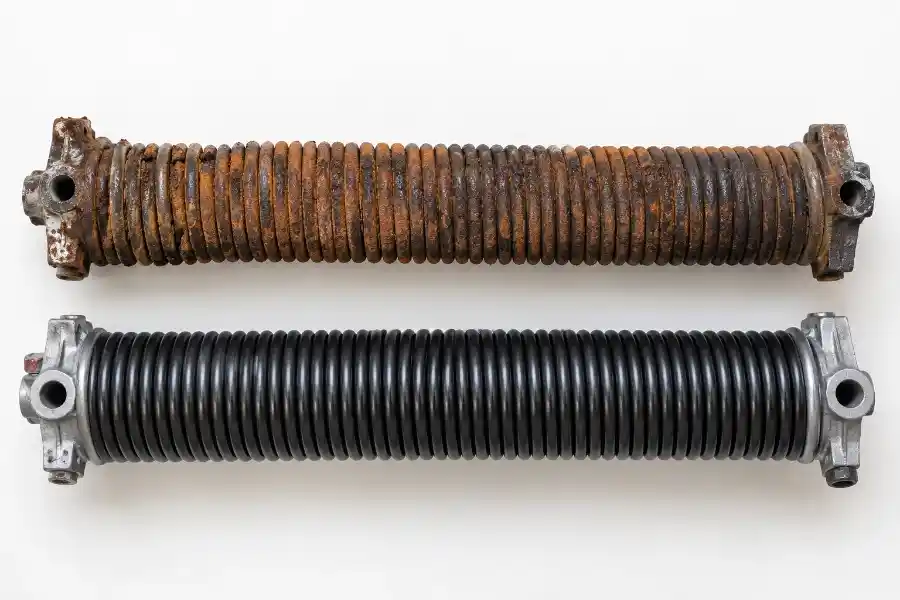
The reason is airborne salt from the Atlantic Ocean and the Intracoastal Waterway. Salt particles deposit on spring coil surfaces and attract moisture, accelerating oxidation on the wire from the outside in. Palm Coast’s thermal cycling — 40-degree temperature swings between winter nights and peak summer afternoons — creates microscopic surface cracks where salt and moisture concentrate. Standard manufacturer warranties don’t reflect any of this. High-cycle springs rated at 25,000 cycles, paired with marine-grade oil-tempered or coated wire, are the appropriate specification for this coastal environment — and the only spec we install in canal-zone and beachside homes.
Highest-exposure neighborhoods in Palm Coast:
F Section / Palm Harbor (canal-adjacent), Hammock Beach / A1A (oceanfront), and Country Club Harbor (marina-adjacent) see the shortest spring lifespans in the market. If your home backs up to a canal, assume the lower end of the 4–7 year range for standard springs.
Know What You Have
Torsion Springs vs. Extension Springs — What Type Is on Your Door?
Almost every Palm Coast home built in the last 20 years uses a torsion spring system. One steel shaft runs horizontally above the door opening, with one or two springs wound around it. When the door closes, the spring winds tighter and stores energy. When it opens, that stored energy releases and does the lifting — counterbalancing a door that would otherwise weigh 150 to 300 pounds.
Extension springs are the older design. They mount along the upper horizontal tracks on either side of the door and work by stretching rather than twisting — more common in Palm Coast construction from the 1990s and in detached garages. Extension spring systems require safety cables threaded through the center of each spring. Without them, a snapped spring becomes a projectile. If you have extension springs and your safety cables are missing or visibly frayed, that is not a minor maintenance note. Both types fail the same way: cycle fatigue, accelerated by salt-air corrosion.
What’s the difference between a torsion spring and an extension spring on a garage door?
Torsion springs sit on a steel shaft above the door opening and store energy by twisting as the door closes. Extension springs run along the upper tracks on either side and store energy by stretching. Most Palm Coast homes built after 2000 use torsion systems — more durable and easier to balance precisely. Extension springs are more common in older construction and detached garages, and they require safety cables to prevent the spring from becoming a projectile if it snaps. Both require professional replacement.
Before It Breaks
What are the Signs That Your Spring Is Failing?
A torsion spring doesn’t always announce itself with a bang. A door that feels heavier than usual when lifted manually, one side rising faster than the other during operation, visible rust pitting or a gap in the spring coil, grinding or squealing during movement, and an opener that strains noticeably on the way up are all signs the spring is failing. Any one of these warrants an inspection before the component fails completely — spring failure under full door load is the scenario where cables snap and doors drop without warning.
The door feels heavy when you lift it manually.
Disconnect the opener via the emergency release cord and try lifting from the bottom. A properly balanced door should float up with light pressure and stay at any height you leave it. If it feels like you’re pulling against resistance, or it drifts back down when you let go, spring tension is compromised.
One side of the door rises faster than the other.
Uneven travel is a balance failure — the springs or cables on each side are at different tension states. Left unaddressed, this stresses the cable drums, tracks, and the bottom corners of the door panels.
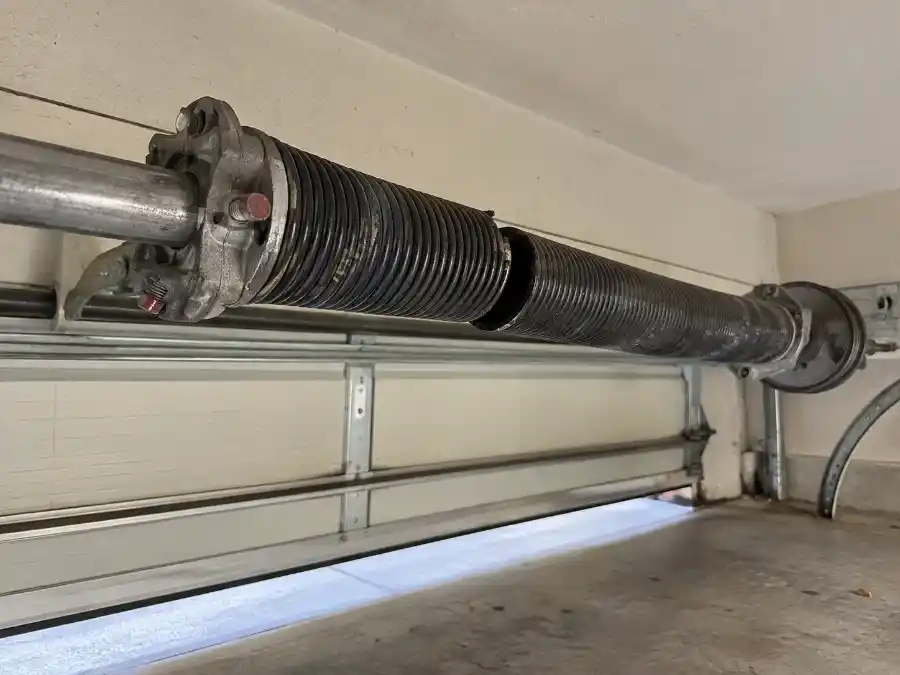
Visible rust, pitting, or a gap in the spring coil.
A gap in the coil means the wire has already started to separate. In F Section and canal-adjacent neighborhoods, inspect the spring surface under bright light every few months — salt-air corrosion that’s invisible in October can open a gap by February.
Grinding or squealing during operation.
Metal-on-metal friction inside a corroding coil. Lubrication masks it temporarily — it doesn’t address what the corrosion is already doing to the wire underneath.
The opener strains noticeably on the way up.
A spring losing tension forces the motor to compensate. Ignore it long enough and you’re adding an opener repair to the spring replacement bill.
How do I know if my garage door spring is about to break?
Disconnect the opener via the red emergency release cord and lift the door manually from the bottom. It should feel light — 10 to 15 pounds of resistance at most — and hold its position at any height without drifting down. If it feels heavy, drifts, or if you can see any rust pitting or gap in the spring coil, the spring is failing. Book an inspection before it fails completely. A spring that breaks while the door is moving can damage tracks, cables, and the door itself — not just the spring hardware.
The Safety Argument
Should You Replace One Spring or Both?
Replace both. Every time. If one spring breaks, the surviving spring has accumulated the same number of cycles, the same salt-air exposure, and the same fatigue history. It is not half-new — it is equally worn, operating under elevated failure risk, and now carrying the entire load of an unbalanced door on its own. Replacing only the broken spring means the second fails within weeks to months, under full door load, without its counterbalance partner. That is the scenario where cables snap suddenly and doors drop without warning.
We replace both springs on every call and explain why before we start. If a second spring appears genuinely recent — replaced within the past year by a prior technician — we document it and discuss honestly. But on a standard Palm Coast service call where both springs have lived the same life in the same coastal environment, there is no case for replacing one.
My garage door opener is running but the door won’t move. What does that mean?
Almost certainly a broken torsion spring. When the spring snaps, the door’s full weight — 150 to 300 pounds — exceeds what the opener’s trolley mechanism can pull. The motor runs, the trolley strains, but the door stays down. The spring is engineered to be the system’s failure point: it’s safer for the spring to break than for the motor to burn out or the door to fall under unmanaged load. This is the most common emergency call we handle in Palm Coast. Same-day repair in most cases: $280 to $380 for a spring pair, installed.
Transparent Pricing
What Spring Replacement Costs in Palm Coast
No service call fee. Written quote before we touch anything.
| Repair | Palm Coast Range | Notes |
| Torsion spring pair — 25,000-cycle coastal | $320–$380 | Standard for canal-zone & beachside homes |
| Torsion spring pair — standard | $280–$340 | Most common replacement |
| Extension spring pair | $220–$300 | Includes safety cable inspection |
| Single spring replacement | $180–$220 | $180–$220 |
| Cable drum (add-on) | $55–$90 | Commonly corroded alongside spring |
| Winding cone inspection | No charge | Included on every spring call |
⚠ Documented scam pattern in Flagler County:
Spring replacement quotes of $800, $1,200, or more without a written itemized breakdown are not Palm Coast pricing. Standard torsion spring pair installed: $280–$380. Get it in writing before anyone starts.
The Right Specification
Why High-Cycle Coastal Springs Matter in Palm Coast
Standard residential torsion springs are rated at 10,000 cycles — sufficient for inland climates where a spring can realistically reach that cycle count before wear ends its life. In coastal Flagler County, salt-air corrosion routinely causes failure well before the spring reaches its rated cycles. The spring doesn’t fail because it ran out of cycles. It fails because the wire deteriorated.
High-cycle springs — 25,000-cycle units wound from heavier-gauge wire — address the cycle count side. Marine-grade oil-tempered or powder-coated finishes address the corrosion side. Neither solves the problem completely; Palm Coast’s environment is aggressive enough that no spring lasts forever here. But a 25,000-cycle coastal spring in an F Section canal home meaningfully outperforms two standard replacements over a 10-year window. For Hammock Beach and Country Club Harbor properties — the highest salt-exposure zones in the market — it’s the only spring we’d install.
They’re on every truck. Not a special order. Not an upcharge conversation that happens after diagnosis — it’s already in the quote if your home’s location warrants it.
Salt exposure by neighborhood:
F Section / Palm Harbor, Country Club Harbor, and Hammock Beach / A1A — high-cycle coastal spring standard. Indian Trails, Matanzas Woods, Pine Grove — standard spring appropriate; high-cycle recommended if prior spring failed in under 7 years.
Safety
This Is Not a DIY Repair
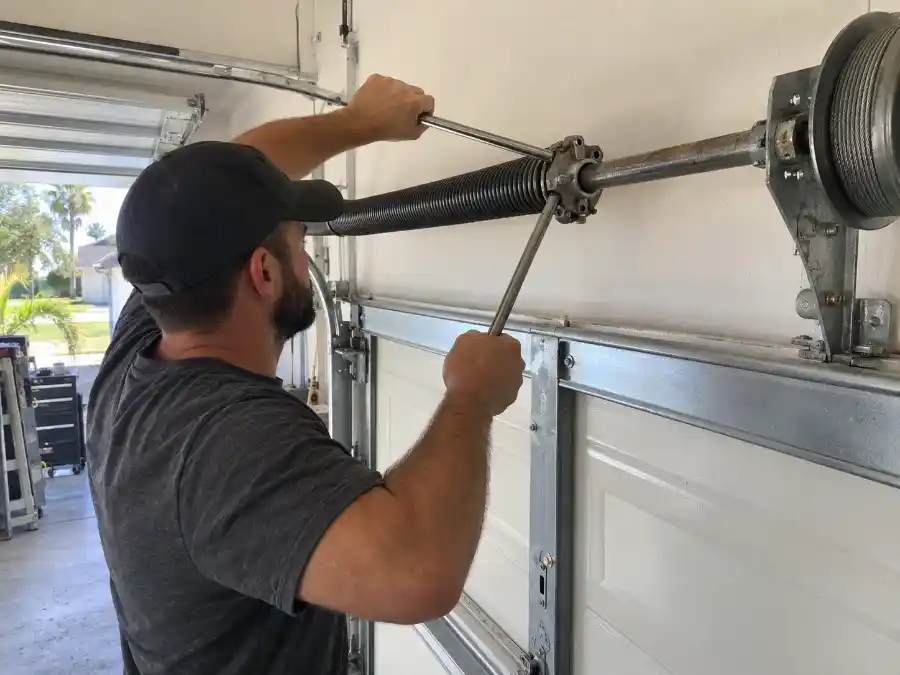
Torsion spring replacement is one of the few home repairs we would actively push back on any experienced homeowner attempting without specific training. The barrier isn’t mechanical complexity — it’s stored energy. A fully wound torsion spring on a standard residential door stores enough mechanical force to cause serious injury if a winding bar slips or the spring releases unexpectedly. The correct procedure requires proper steel winding bars — not a screwdriver, not rebar — and knowledge of the precise number of turns required for your specific door weight, cable drum diameter, and spring specification. That number is not universal. Getting it wrong means a door that’s either too heavy to open safely or so spring-loaded it flies open uncontrolled.
Do not attempt to operate a door with a suspected broken spring.
A residential door weighs 150–300 lbs. Without the spring’s counterbalance, that weight is fully unmanaged. Leave the door where it is. Pull the emergency release cord only if you need to access your vehicle, and assess carefully before attempting any manual lift.
Can I replace my own garage door spring?
Technically possible for someone with the right training and specific steel winding bars — not a screwdriver, not rebar, not the bars improvised from hardware-store stock that appear in some tutorials. In practice, the stored tension in a residential torsion spring is enough to cause serious injury if a winding bar slips during the process. The correct winding procedure requires knowing the exact turns-per-inch spec for your spring, door weight, and cable drum diameter. Extension springs carry a different risk — they can become projectiles when they snap during a live replacement attempt. At $280 to $380 for professional replacement, the cost-to-risk ratio doesn’t favor attempting it yourself.
Real Call — Flagler County
F Section Canal Home, Palm Harbour Pkwy
Case Study · Torsion Spring Failure
Standard spring at year five — snapped overnight, second spring weeks from following
Situation:
Homeowner called at 6:45 AM on a Monday. Loud bang from the garage overnight — heard it from the bedroom. Door wouldn’t open in the morning. Opener ran normally but nothing moved.
Found:
Left torsion spring snapped clean near the winding cone. Right spring had visible rust pitting across three inches of coil and two small gaps — started to separate but hadn’t finished. Cable drum on the left side showed surface corrosion and light grooving. Both springs original to the home, approximately 5 years old.
Done:
Replaced both torsion springs with 25,000-cycle high-cycle coastal-rated units. Replaced left cable drum. Applied silicone lubricant to all hardware, hinges, and roller shafts. Balanced door, verified cable tension, ran five full open-close cycles before leaving.
🔑 Lesson Learned
Five years on an F Section canal home is not early failure — it’s the expected lifespan for a standard spring in that environment. The right spring was roughly 72 hours from the same outcome. Replacing both on this visit saved a second service call, a second labor charge, and the safety risk of an unbalanced door dropping on a stressed cable.
💰 Total: $365 — $310 (25,000-cycle coastal spring pair) + $55 (cable drum) + labor
Common Questions
Garage Door Spring FAQ — Palm Coast, FL
Spring Broken? Opener Running But Nothing Moving?
Call us — same-day service on most spring calls. We dispatch from Palm Coast, not Daytona.
No service call fee. Written quote before any work. 90-day labor warranty in writing.
Serving: Indian Trails · F Section / Palm Harbor · Grand Haven · Matanzas Woods · Hammock Beach · Del Webb Flagler Beach · Flagler Beach · Bunnell
ZIP codes: 32135 · 32137 · 32142 · 32164